



What a Working Studio Needs Between One Attempt and the Next
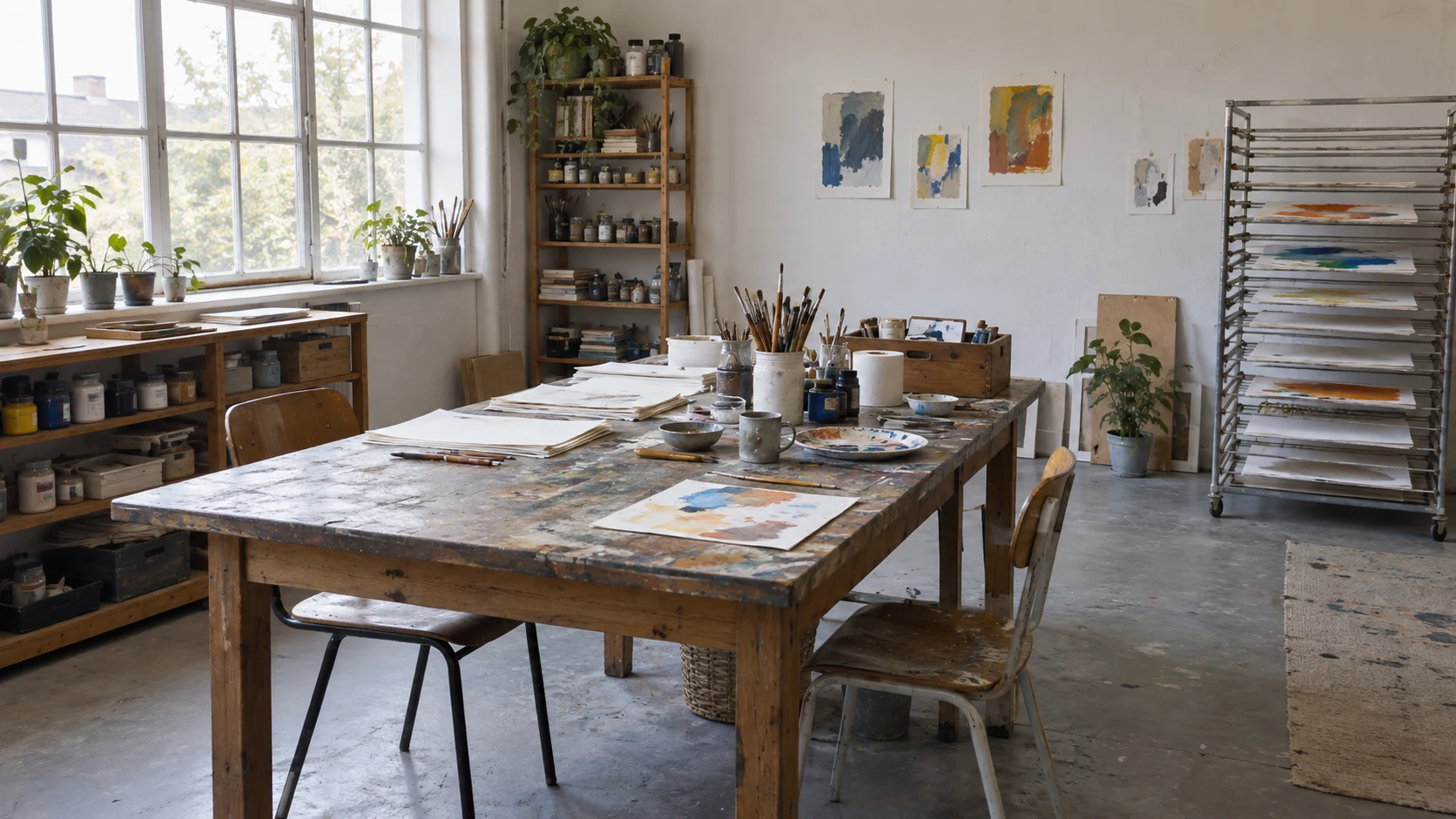
A studio photograph tends to turn a working room into a portrait: an orderly table suggests discipline, a crowded floor suggests intensity. Neither tells us much about how the room actually supports an unfinished task. A more revealing question is what happens between attempts. Where can a wet piece wait, how does a rejected trial remain available, and what must be moved before work can begin again?
Consider a room used mainly for painting. Its valuable wall may be the one kept partly empty, because a fresh panel needs to be seen away from the table where it was made. Drying racks separate works that cannot safely touch, while a clear shelf can hold colour tests in a stable order. The arrangement does not have to look immaculate. It has to make particular distinctions legible: wet and dry, current and stored, available and reserved. If finding a brush requires shifting a fragile surface, the room turns a small practical need into a decision about risk. A useful studio reduces that kind of accidental negotiation.
A useful studio keeps an unfinished question available without leaving every object in the way.
Bea Harker
Object making changes the pattern. A table must accommodate looking around a form, and the position that suits construction may conceal the view that matters most. A movable board can allow a prototype to turn without lifting it by a vulnerable part. Small pieces benefit from shallow trays with plain labels, especially when two almost identical versions differ at one joint. Storage becomes part of thinking because an earlier solution can be brought back into the discussion. Discarding everything quickly creates a false impression of a straight path to the final object; keeping everything indiscriminately makes comparison equally difficult. Selective retention gives the next attempt something precise to answer.

In a shared room, arrangements have another audience. A clear worktable at the end of the day is less useful if nobody knows whether the objects on it can be moved. A short note stating what is drying, what is open to comment and what needs to stay in place can prevent a surprising amount of friction. Collaboration also needs a space in which unfinished work can be discussed without blocking a tool or doorway. This might be a section of wall and two chairs rather than a separate meeting area. The important provision is time and visibility: both makers should be able to see the same thing before trying to resolve their different accounts of it.
These considerations make modest changes worth testing. Move a rack closer to the task it serves, separate reference material from drying work or reserve one small surface for comparison. Then observe whether starting and stopping become easier over several sessions. A room may still be cramped, imperfectly lit or shared on an awkward schedule; no arrangement erases those constraints. Yet the studio can make them more explicit and less disruptive. Its character emerges through such practical choices, not through the amount of equipment on display. The best clue in a room is often the small provision that lets its occupant return to a question without having to reconstruct the whole day.