


The story of Ternform
A gallery built around looking
Bea Harker
Writing and interpretation
Owen Ash
Arrangement and learning
From a shared table to a wider conversation
Ternform began, in the story of this edition, with Bea Harker and Owen Ash comparing notes across a borrowed worktable. One was interested in the words that make an image accessible; the other in the distance, light and sequence through which someone encounters it. They kept returning to the same practical question: what helps a visitor look again?
The answer was rarely a longer wall label on its own. Sometimes it was a seat, a view of another work or a small detail placed where it could be examined closely. Those observations became a programme joining painted walls, sculptural objects and experiments with colour.
A gallery can make room for specialist knowledge while still giving a first-time visitor a useful starting point. Ternform begins with something visible and lets the conversation grow from there.
Bea edits the journal and the interpretive writing. Owen considers how a sequence of encounters can move between attention and rest. Their imagined roles overlap at the worktable, where a promising description is tested against a particular image and a display idea is asked to explain what it offers the person approaching it.
The present edition brings together eight artists and ten exhibition accounts. A beginner workshop adds making to the conversation, while the journal gives slower questions somewhere to develop. The result is a gallery programme with several entrances: a colour, a gesture, an object or a sentence that makes you curious.
Our starting point
Give every visitor a particular place to begin, enough context to keep looking and room to arrive at an interpretation that can remain their own.
How the idea took shape
Milestones in Ternform's fictional founding story.
- 2018
A shared worktable
Bea and Owen begin comparing short image descriptions with small display studies, looking for the point where writing and arrangement help one another.
- 2019
Notes for a second look
A set of imagined reading sheets develops around ordinary questions: where to begin, what changes at a distance and which details deserve more time.
- 2020
The room on paper
The pair draw a gallery with places to pause between images, testing clear routes and quieter areas before choosing a programme to fill it.
- 2021
From walls to objects
The programme idea broadens to include mural studies and sculptural arrangements, with particular attention to supports, coverings and the conditions in which an image is encountered.
- 2022
Making enters the conversation
An introductory workshop outline connects permission, preparation and observation with simple mark-making, giving beginners a considered route from looking at an image to making one.
- 2024
A longer journal
Studio conversations join practical guides and exhibition writing, allowing questions raised by the programme to develop beyond a caption or a brief first encounter.
- 2026
The current edition
Eight fictional artists, ten exhibition accounts and sixteen journal stories come together as a coherent programme, with a shared set of dates and visit information.
Ways to work with an idea
An artwork is encountered through more than its image. A room, a written brief and a useful conversation can each change what becomes possible to see.
These five service outlines explain how Ternform approaches a project. Explore the relevant information, then prepare a local enquiry note with the scale, timing and access questions that would shape a real discussion.
- 01
Art advice
Begin with the room and the people using it. We consider scale, sightlines, light and the questions an artwork might invite, then help organise a brief that makes preferences and practical constraints visible before any work is selected.
Prepare an advice enquiry - 02
Practical workshops
A useful introduction gives a beginner time to understand a surface, try a controlled mark and compare the result. Our First Marks, Open Walls outline combines street-art context with equipment, deliberate practice and a small composition that can be discussed without a competitive finish.
Explore the workshop - 03
Space for a gathering
A conversation, reading or small reception begins with a clear account of attendance, timing and access. Consider how the event will sit alongside a gallery programme, including sound, furniture and the protection of displayed work.
Plan an event enquiry - 04
Buying and placing art
Separate enjoyment of an image from the practical questions of a purchase. Our enquiry outline covers provenance, condition, display requirements and available documentation; it does not offer valuations, investment returns or works for sale.
Prepare a collection enquiry - 05
Commission conversations
A commission needs a shared brief before it needs a promised result. Set out the setting, purpose, permissions, budget range and review points so an artist can assess the proposal without being asked to work without a clear starting point.
Outline a commission
Space to stop and look
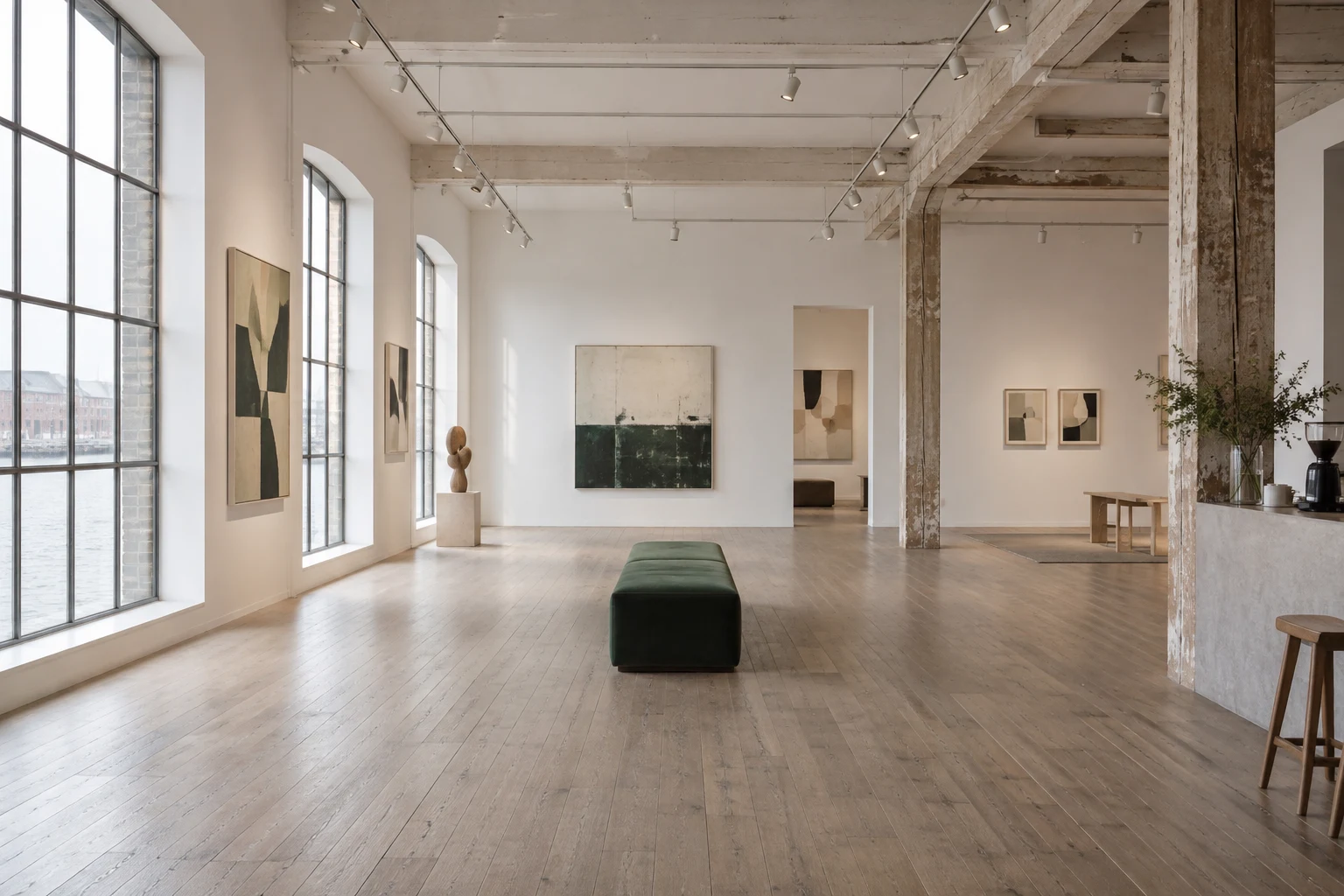
The Example Wharf rooms are an imagined setting for this edition: a sequence of open gallery spaces, places to sit and a worktable where looking can become conversation.
- 8
- Artists in this edition
- 10
- Exhibition accounts
- 16
- Journal stories
Take a seat between images
The café is conceived as a pause within a visit, with a clear table, something warm to drink and enough room to return to a conversation. It belongs to the rhythm of looking, rather than marking the moment a visit has to end.
Our sample menu describes a small selection of drinks and light food. Prices and ingredients are illustrative. A real café would confirm current availability, dietary requirements and allergen information directly before accepting an order.
Read the sample menuFind your starting point
Use the shared hours and visit outline to explore the programme. Example Wharf is an imagined London setting, with no real map pin or public entrance.
Example Wharf rooms
London · imagined venue
- Monday–Tuesday
- 12:00–19:00
- Wednesday–Friday
- 14:00–20:00
- Saturday–Sunday
- 15:00–21:00
Imagined sequence · no real route or entrance
Give a good conversation room
Think through a reading, discussion or small gathering among the ideas of a gallery programme. Start with people, timing and the kind of attention the event needs.
Plan an event enquiry